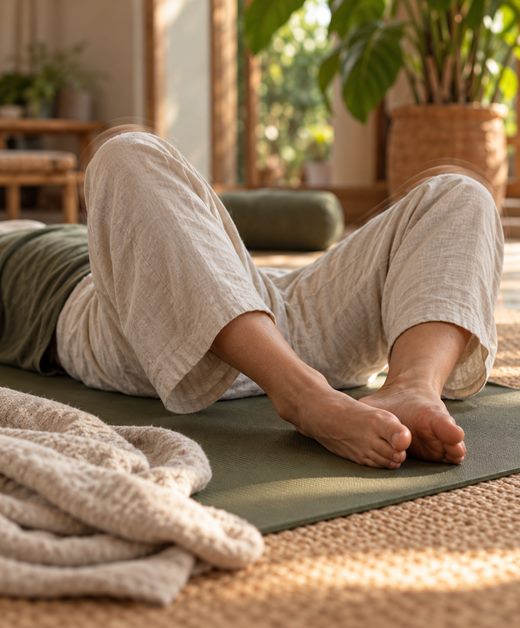
Your thoughts are spinning, and you want a breath practice that steadies you without making you dizzy or light-headed. Grounding breathwork stays gentle and paired with the feel of your body in the room.
In short: grounding breathwork keeps the breath slow and natural while you feel your body's contact with the floor or chair. Avoid forcing deep breaths; a gentle, longer exhale is enough.
Keep the breath gentle
NHS inform notes that controlled breathing can help you feel calmer and is particularly helpful if you feel dizzy or light-headed when anxious. Cleveland Clinic explains that rapid, deep breathing (hyperventilation) lowers carbon dioxide and can cause dizziness, tingling and chest pain. If that happens, stop, return to normal breathing, and sit or lie down.
Harvard Health notes that breath focus may not be appropriate for people with health problems that make breathing difficult, such as respiratory ailments or heart failure. Check with a doctor if unsure. Skip breath holds if they feel strained, or if you have heart, lung or seizure conditions without medical advice.
Four short techniques (about two minutes each)
1. Feet and exhale
- Feel both feet on the floor.
- Breathe in gently through the nose.
- Breathe out a little longer than you breathed in. Repeat for about two minutes.
2. Balloon belly (NHS inform grounding breath)
- Imagine an empty balloon in your stomach.
- Inflate it by breathing in through your nose for a count of three.
- Deflate it slowly through your mouth. Repeat until you feel a little calmer.
3. Controlled breathing (NHS inform)
- Breathe in through the nose for 3 seconds.
- Hold for 3 seconds (optional; skip if uncomfortable).
- Breathe out through the mouth for 3 seconds.
- Hold for 3 seconds (optional). Repeat for a few minutes.
4. Hand on belly
- Rest one hand on your belly and one on your chest.
- Let the belly hand move more than the chest hand as you breathe slowly.
- Keep the breath small and quiet, not maximal.
What you might notice: a slightly slower breath, more awareness of your feet, or light-headedness if you overdo it. How to stop: return to normal breathing and look around the room.
Is this the same as breathwork?
It is a gentle form of breathwork. More intense styles with rapid breathing or long holds are different and not covered here. For more options, see breathing exercises for stress and grounding techniques. These practices are wellness education and can sit alongside professional care, not replace it.